Dogs can detect Covid with excessive accuracy, even asymptomatic circumstances
Warning: Undefined variable $post_id in /home/webpages/lima-city/booktips/wordpress_de-2022-03-17-33f52d/wp-content/themes/fast-press/single.php on line 26
2022-06-03 08:42:17
#Canines #detect #Covid #high #accuracy #asymptomatic #instances
Questions on whether or not canine can sniff out Covid — and the way well — have intrigued researchers since early in the pandemic.
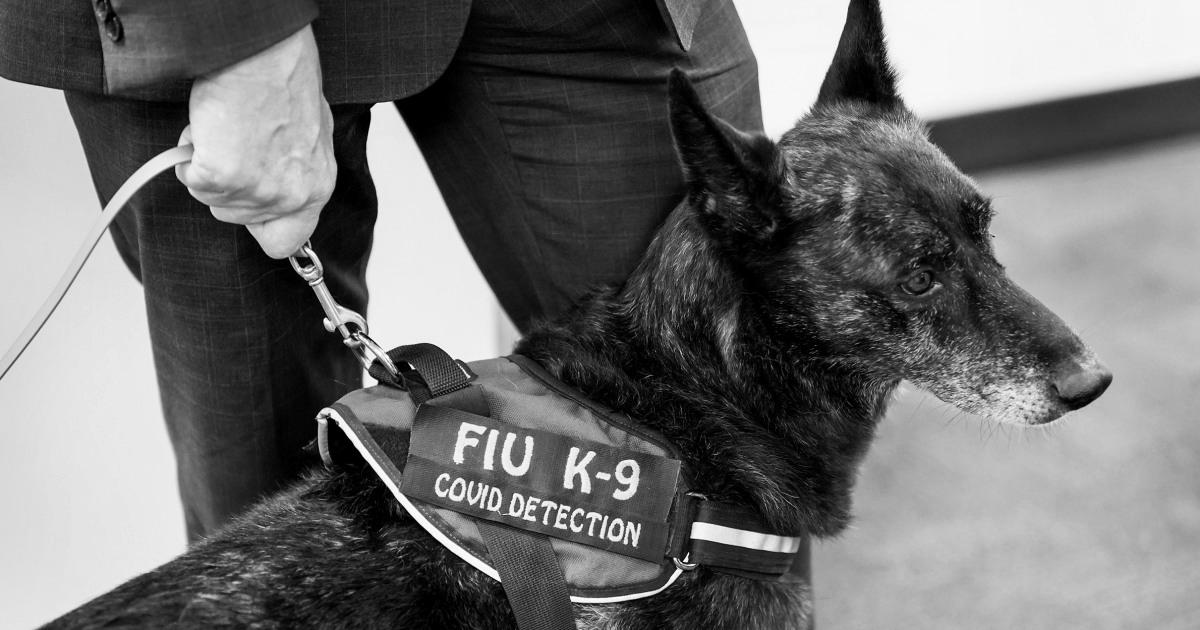
A study revealed Wednesday within the journal Plos One presents further proof that canines can indeed be trained to detect Covid. The dogs tested in the research accurately identified 97 % of positive instances after sniffing human sweat samples. That made them more sensitive than some speedy antigen assessments.
The samples have been collected at community facilities in Paris from a mixture of symptomatic and asymptomatic instances, in addition to healthy folks without Covid. The researchers discovered the canine to be especially good at detecting asymptomatic infections, with a sensitivity nearing one hundred pc.
Previous studies have additionally highlighted this canine skill: Researchers in Florida last year found that that canines may predict positive Covid assessments with 73 to 93 percent accuracy after a month of coaching. In a U.Okay. research, dogs accurately pinpointed 82 to 94 % of constructive cases.
The brand new research was conducted in early 2021, so the dogs have been identifying the original coronavirus. Dominique Grandjean, one of many study’s authors and a professor on the Alfort National Veterinary College in France, mentioned he’s now analyzing how nicely dogs decide up on variants.
Grandjean said his findings suggest that canine is perhaps helpful for detecting Covid in airports, nursing homes, schools, or sporting events. Already, dogs have helped sniff out Covid at airports in Saudi Arabia, Finland and the United Arab Emirates.
Canines "only need a few molecules" to establish a constructive case, Grandjean said.
But Dr. Cynthia Otto, director of the Penn Vet Working Dog Middle at the College of Pennsylvania, stated it is difficult to coach canine to detect Covid in the real world.
"The best — and I might think about it the Holy Grail — is that the dog is simply standing there, an individual walks by, and they say, 'Yes, no, sure, no, yes, no,'" Otto said. "That eventually could be achieved, but ensuring it’s accomplished with all the right controls and quality assurances and safety — it’s a giant step. I haven’t seen anyone who has proposed the best way to make that transition in a manner that’s scientific and safe."
A less invasive way to detect Covid?For the new research, researchers educated five canines by rewarding them with toys for detecting a optimistic Covid sample.
The canine then sniffed 335 sweat samples, 109 of which were positive on PCR lab tests. Every sample was placed in a tiny field behind a cone, with the cones lined up in rows of 10. If a canine thought it detected a optimistic case, it could sit down.
Grandjean estimated that it took just 15 seconds for the dogs to analyze 20 Covid samples. When it got here to categorizing damaging samples — generally known as specificity in testing — the dogs were barely less correct. They recognized 91 percent of the Covid-free samples appropriately, meaning they gave some false positives.
Nonetheless, Grandjean mentioned, dogs provide a couple advantages for Covid testing: They’re much less invasive than a nasal or throat swab and supply extra immediate results (not counting the coaching time).
Each Grandjean and Otto also mentioned that dogs have demonstrated a capability to detect infections earlier in the course of an individual’s sickness than PCR assessments. In lots of instances, Grandjean hypothesized, someone who exams destructive on a PCR but optimistic according to a dog’s evaluation will seemingly test constructive on a PCR two days later.
Otto said canine would possibly therefore be a helpful prescreening tool to flag potential circumstances that would later be confirmed in a lab.
'Don’t do that at dwelling'Before the pandemic, Grandjean was studying whether canine may sniff out colon most cancers. In 2020, he switched his focus to Covid. His analysis involves labradors, German shepherds and Belgian shepherds, and he previously discovered that dogs can detect Covid from sniffing a person’s mask.
A part of the reason canines can do this, Grandjean stated, is that they have an organ in their noses referred to as the Jacobson’s organ, which helps them establish smells that seem odorless to people. That's how dogs can choose up on coronavirus proteins.
Canines also can smell volatile natural compounds, or gases found in exhaled air, saliva or sweat. Grandjean mentioned Covid has certain risky natural compounds that dogs detect, but "we don’t know exactly what they are chemically."
Grandjean stated any breed could detect Covid if it enjoys playing and doesn’t have a shortened snout. Different animals, like cats, have similarly sturdy senses of smell, he added, however canine are easier to coach.
However, the coaching course of is very technical, Otto stated. Outdoors odors can interfere, and it’s not always straightforward to tell if canines are trying to find the right scent. Dogs are taught utilizing positive reinforcement; related strategies are used to train them to find termites or sniff out drugs. But in fact, not all dogs like the same rewards, Otto mentioned.
"For some dogs, a ball is likely to be the best possible thing on the earth, where another canine would possibly think that a tug toy or a squeaky rabbit is the best factor," she stated. Other canine, in the meantime, simply "get really tired of it."
What's extra, Otto added, a canine's capability to detect Covid in a sweat sample or piece of clothes doesn't necessarily imply it is going to be in a position to take action when dealing with an actual person.
"That’s one of many massive challenges — to have the dog learn to translate from a sample to an entire human being, which is a much more advanced odor," she said.
For anyone hoping to train their very own pet to smell out Covid, Otto had some recommendation: "Don’t do that at residence."
Quelle: www.nbcnews.com